


From Childhood Creations to Fragmented Cubism – The Rise of Contemporary Artist Mr. Pinkbrush

Updated: Jun 4
Fragmented Cubism as a New Movement
In the work of Fabian Frohly (Mr. Pinkbrush)
Fragmentation changed painting once. Today, it is changing our understanding of identity.
When Pablo Picasso and Georges Braque fragmented the figure, they transformed the space
of painting. When contemporary artists fragment characters today, they transform meaning.
Fragmented Cubism emerges precisely at this point – where fragmentation shifts from the analysis of form toward the exploration of identity.
Developed through the work of Fabian Frohly, known as Mr. Pinkbrush, Fragmented Cubism proposes a new movement within Contemporary Character Painting.

Fragmentation Was Never Style – It Was Knowledge
Within Analytical Cubism, fragmentation was never merely a stylistic choice.
It was a form of analysis. Showing multiple perspectives simultaneously meant making time visible, making perception visible and ultimately rethinking reality itself.
Institutions such as the Museum of Modern Art in New York and the Musée Picasso Paris continue to illustrate that fragmentation was never simply a visual language.
It functioned as a structure for understanding reality itself. Today, that function shifts once again.
Fragmentation no longer primarily describes space.
It begins describing identity.
Current Contemporary Art Is Not Built Overnight
Fragmented Cubism did not emerge suddenly. It evolved over decades through drawing,
street culture, realism, symbolism and the continuous exploration of identity.
What appears today as a unified visual language began much earlier through sketches, characters, movement and recurring visual structures that gradually developed over time.
The Evolution Behind Fragmented Cubism (1992 – 2026)
1992 – 2000
Early drawing, comics, character sketches and first visual experiments.


Looking back today, even these early sketches reveal recurring visual structures – exaggerated facial forms, expressive character constructions and emotional exaggerations that would unexpectedly reappear decades later.
Early Visual DNA and Recurring Structures
Looking back at the early comic character Mr. Friesi (1994), several visual structures become visible that continue to reappear decades later.
The masked figure – inspired by comic characters such as the Beagle Boys and Phantomias from DuckTales – already introduced themes of hidden identity and transformation.
Even more striking are the simplified eye structures and profile construction, which remain visible within later works such as Pinocchio and other developments that eventually became part of Fragmented Cubism.
Rather than functioning as exact repetition, these elements reveal a recurring visual DNA that continued evolving across more than three decades.
Comparison
Mr. Friesi Eye & Profile (1994) – Pinocchio Eye & Profile (2026)
From Sketchbooks to Walls – Graffiti and Urban Visual Culture
2000 – 2008
What began with comics and sketchbooks gradually expanded into walls,
public space and direct visual experimentation.
Graffiti became more than an influence. It became a lived visual language.
During these years, movement, urban rhythm and raw energy began shaping
the work in a more direct way.


First Graffiti Wall by Fabian Frohly (Mr. Pinkbrush), 1994
Books such as Subway Art and Spraycan Art opened access to a broader visual culture
and expanded the view far beyond traditional drawing practice.
Looking back today, this period marked a decisive expansion: drawing was no longer limited
to paper. Images gradually moved into public space, movement and lived experience.

STAF, Graffiti Sketch, 1994

STOP VANDALS, Graffiti Sketch, 1998
Rather than focusing only on typography, attention increasingly shifted toward characters, identity and visual storytelling.
Walls became spaces of experimentation where figures and narratives could develop more freely.
What initially appeared as graffiti gradually evolved into something larger – an exploration of movement, visual identity and character construction.
Young Mr. Pinkbrush Painting Graffiti Wall
As graffiti gradually moved beyond sketchbooks and comics, walls became spaces of
direct visual experimentation. Characters, movement and raw visual energy could develop more freely within public space. Rather than focusing only on letters, the attention increasingly shifted toward character, identity and visual storytelling.

Young Mr. Pinkbrush Painting Graffiti Wall, 1994
An early photograph documenting Fabian Frohly’s first direct engagement with graffiti, urban visual culture and
public-space experimentation. What began through comics and sketchbooks gradually expanded into walls,
movement and lived visual experience – marking an important early step toward character construction,
visual storytelling and the later development of Fragmented Cubism.
Subway Art + Spraycan Art
Books such as Subway Art and Spraycan Art became important early influences and gradually opened the door to a visual world extending far beyond traditional drawing.
They revealed characters, graffiti, movement and an urban visual language that later became part of a much larger artistic evolution.
Beyond their visual impact, these books slowly became part of everyday life.
Countless hours were spent turning their pages at home, often late at night in a childhood bedroom, studying graffiti, characters and visual details over and over again.
They were carried in school bags, shared with close friends and revisited whenever possible.
Drawing graffiti, characters and sketches became a constant habit –
sometimes even during school lessons.
Over time, these books became more than references. They became part of a personal visual world that, looking back today, would later grow into a much broader artistic language.

Spraycan Art & Subway Art – Foundations of Urban Visual Culture, 1992
Early Drawing as the Foundation of Later Image Structures
2010 – 2015
Following years of comics, graffiti and visual experimentation, the focus gradually shifted
toward observation, symbolism and psychological depth.
Charcoal drawings, oil paintings and figurative studies became part of a more introspective phase, where animals, portraits, masks and symbolic narratives were no longer approached simply as subjects, but as ways of exploring emotion, identity and human presence.

The Boy, Charcoal and Graphite on Fabriano Paper, 100 × 150 cm, 2014
Looking back today, many of these works already reveal themes that would later become increasingly important within Fragmented Cubism. Symbolic structures, emotional complexity and layered meanings gradually moved into the foreground.


Panda, Charcoal on Paper, 70 × 100 cm, 2016 Mask, Charcoal and pastel on Paper, 200 × 150 cm, 2016
This period marked an important transition – from constructing characters toward
exploring psychological space.

Heaven and Hell, Charcoal, Graphite and Phosphorescent Pigments on Fabriano Paper, 200 × 150 cm, 2015

Dynamic Animation Sketch Technique
and the Transition Toward Fragmented Cubism
2020 – 2025
The years leading toward Fragmented Cubism marked a decisive shift in the evolution of the work.
During this period, the Dynamic Animation Sketch Technique gradually emerged – a visual approach inspired by drawing, visible construction lines and the movement logic of traditional animation studios.
Life, Painting on Canvas, 150 × 150 cm, 2025 Everybody can be a hero, Painting on Canvas, 300 × 225 cm, 2025
Figures never appeared completely static. Visible sketches, open structures and subtle variations generated rhythm, energy and personality. Unlike traditional painting methods, the construction itself remained visible.

Smile, Oil, Acrylic and Charcoal on Canvas, 150 × 150 cm, 2022
Sketch-like lines, open areas and spontaneous marks intentionally became part of the image. Movement was no longer simply represented. It gradually became embedded within the structure of the image itself.

Hurricane, Oil, Acrylic, Charcoal on Canvas, 115 x 150 cm, 2024
Parallel to this development, a collaboration with Warner Bros. Entertainment and DC Comics emerged through Limited-Edition Artworks based on original Animation Cells.


Tom & Jerry / Batman Animation Cells – Warner Bros. Entertainment & DC Comics Collaboration, 2024
Looking back today, the Dynamic Animation Sketch Technique became an important bridge connecting drawing and painting, movement and structure, animation and figurative art.
Many visual mechanisms later visible within Fragmented Cubism began to emerge here.
The Crew & Mr. Pinkbrush World - Museum Ground, South Korea
The works The Crew and Mr. Pinkbrush World by Fabian Frohly (Mr. Pinkbrush) were acquired and exhibited by Museum Ground - a contemporary art museum in South Korea known for presenting internationally recognized contemporary artists and immersive contemporary exhibitions.
Mr. Pinkbrush World (left), The Crew (right), Oil on Canvas, 150 x 150 cm, 2023, Museum Ground, South Korea
Both paintings were created in the format 150 × 150 cm and feature fragmented visual structures, layered character compositions and expressive contemporary figuration that became increasingly important within the later development of Fragmented Cubism.
The acquisition and exhibition of these works marked an important institutional step within the international artistic development of Mr. Pinkbrush and his evolving contemporary visual language.
Early Fragmented Sculpture – “Skull” Age 6 / 7
This early sculpture was created at approximately six to seven years old in France, within an environment deeply shaped by renovation work, raw materials and physical labor.
The very old sandstone mill, renovated by the parents, simultaneously became the family’s home. Surrounded by rubble, sandstone, Ytong blocks, concrete and unfinished construction structures, Fabian Frohly began experimenting intuitively with material and form.
The sculpture itself was created from a found Ytong block using simple construction tools including a pointed hammer, chisel, file and drilling tools.
The Skull, 22 x 18 x 5 cm
Looking back today, the work appears less like a traditional child sculpture and more like an early fragmented form positioned somewhere between object, face and psychological structure.
The central opening already functions like the empty eye socket of a skull, while scraped surfaces and primitive skull-like teeth begin organizing the object into a fragmented face.
Even within this intuitive childhood work, the object already begins moving beyond pure material experimentation. Early ideas of visible fragmentation, open identity and psychological tension already begin to emerge.
Although the sculpture was created decades before Fragmented Cubism, it already reveals modes of thinking that would later become central within the artistic development: visible fragmentation, psychological tension and the figure as an open rather than fully closed form.
Skull - Pinocchio Fragmented Cubism Sculpture
Although more than three decades separate the early “Skull” sculpture from the later Pinocchio Fragmented Cubism sculpture, both works reveal a surprising continuity in visual and psychological thinking.
The Skull, 22 x 18 x 5 cm Pinocchio , 29 x 20 x 15 cm, 2026
Both sculptures move away from classical sculptural perfection and instead work with visible construction, fragmentation, instability and emotional tension.
Within “Skull,” fragmentation appears intuitively through raw material and damaged form.
In the later Pinocchio sculpture, the same logic becomes more consciously structured while
facial elements shift, overlap and separate without losing the emotional presence of the figure.
The early “Skull” sculpture therefore appears less as an isolated childhood object and more as
an early origin of the fragmented sculptural logic that later evolved into Fragmented Cubism.
Within the later sculptural process, each work begins with a drawing on paper, followed by
a hand-formed model in oil-based clay before gradually evolving into bronze.
Fragmentation therefore no longer functions only pictorially.
It becomes spatial.
Fragmented Cubism in the Work of Fabian Frohly
By 2025–2026, earlier developments gradually converged into a more unified visual language.
Drawing, graffiti, symbolic studies, sculpture and Dynamic Animation Sketches no longer existed as separate phases. They increasingly began interacting within the same image.
Visible lines remained present. Movement continued shaping the image while character construction evolved beyond purely formal concerns.
The figure gradually became a psychological space where identity, memory and emotional complexity could coexist simultaneously.

Fragmented Cubism and Contemporary Character Painting
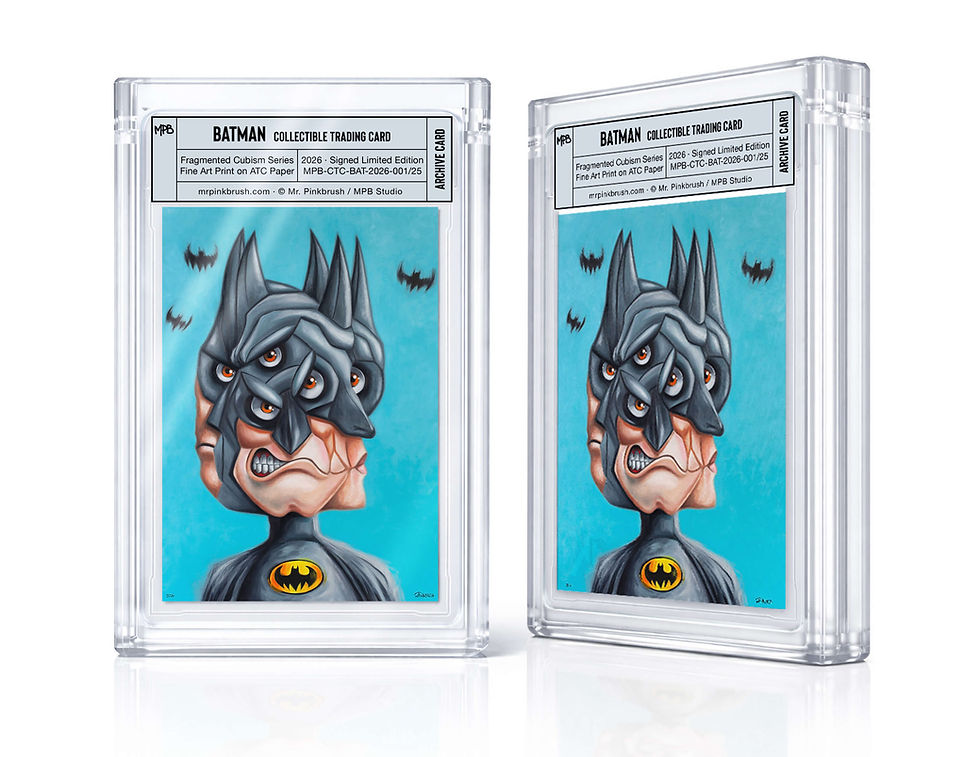
Within Fragmented Cubism, globally recognizable figures are no longer treated simply as illustrations or cultural references.
They transform into structures where memory, identity and emotional projection intersect. Different emotional conditions no longer appear separately. Multiple realities can exist simultaneously within the same figure.

Developed on the Côte d’Azur – a region deeply connected to Cubism through Pablo Picasso’s work in Antibes, Vallauris and Mougins – Fragmented Cubism continues this dialogue through
a contemporary visual language. The practice of Swiss-French artist Fabian Frohly, known as
Mr. Pinkbrush, explores the psychological and cultural resonance of cartoon iconography within 21st-century contemporary figurative painting.


Since the 1990s, artists such as Takashi Murakami, George Condo, KAWS and Daniel Arsham have reshaped the relationship between contemporary art and global image culture.
Fragmented Cubism differs in one fundamental way.
Rather than using fragmentation as surface language or visual quotation, fragmentation itself becomes part of the figure’s internal structure. It moves beyond stylistic interpretation and becomes integrated into the construction of identity itself.


The Kiss, Oil Painting on Canvas , 90 x 120 cm, 2026
Alongside this development, collaborations with Warner Bros. Entertainment and DC Comics, together with exhibitions through Art Miami, Palm Beach Modern + Contemporary,
Museum Ground in South Korea, Les Galeries Bartoux, Markowitz Fine Art and Corridor Contemporary increasingly positioned the work within the international field of
Contemporary Character Painting.

Fragmentation as the Future of the Figure
Cubism was never finished.
It was a beginning.
Within Fragmented Cubism, fragmentation is no longer limited to the analysis of space.
It shifts toward questions of memory, identity and image history.
The image no longer functions as a fixed representation.
Instead, it becomes a place where multiple realities, emotions and identities can
exist simultaneously.
And with it, the figure itself begins to change – no longer simply as something to observe,
but as something to experience.
Continue reading:


Comments