


Fragmented Cubism Today – Contemporary Figurative Painting

Updated: Apr 17
Fragmentation is the central organizing principle of Cubism. From its origins in the early
20th century to contemporary artistic positions today, it has remained a powerful visual
tool for deconstructing reality, identity, and perception.
In contemporary character painting, fragmentation no longer serves merely as an analytical breakdown of form. It has evolved into an expressive visual language - one that combines geometry, narration, psychology, and cultural symbolism. Faces, figures, and iconic characters
are fractured, multiplied, and reassembled to reflect the complexity of today’s visual culture.
This evolution is widely discussed within the context of Cubism Art Today, where classical cubist principles are examined in relation to contemporary themes, pop culture, and global visual codes.
From Analytical Cubism to Contemporary Character Fragmentation
The foundations of Cubism were established by Pablo Picasso and Georges Braque.
Their radical rejection of linear perspective and the simultaneous depiction of multiple
viewpoints fundamentally transformed the understanding of painting.

Today, this principle extends far beyond traditional still lifes or portraits. Contemporary cubist character painting employs fragmentation to represent:
• iconic figures and archetypes
• fictional and pop-cultural characters
• symbolic constructions of identity
• emotional and psychological states
Institutions such as the Museum of Modern Art, the Centre Pompidou, and Tate Modern
continue to demonstrate how deeply fragmented thinking has shaped the visual language
of contemporary art.

Fragmentation, Identity, and the Contemporary Gaze
In the contemporary context, fragmentation is no longer purely analytical but deeply narrative and symbolic. Fragmented faces represent fractured identities, parallel realities, and the constant flow of images that define modern life.
Artists such as George Condo explore psychological fragmentation, while internationally established figures have likewise integrated fragmenting strategies, deconstruction,
and cubist modes of thinking into their own visual languages.

Damien Hirst, for example, engages with both physical and conceptual fragmentation through seriality and the dissection of bodies, symbols, and perception.
KAWS deconstructs iconic figures through formal reduction, overlay, and repetition,
while Daniel Arsham interprets fragmentation as temporal and material erosion.

These diverse positions demonstrate that fragmentation today extends far beyond classical Cubism and has become a central strategy of contemporary art production,
both figurative and conceptual.

It is precisely within this field-between psychological distortion, iconic recognizability,
and contemporary visual language-that new artistic positions emerge.

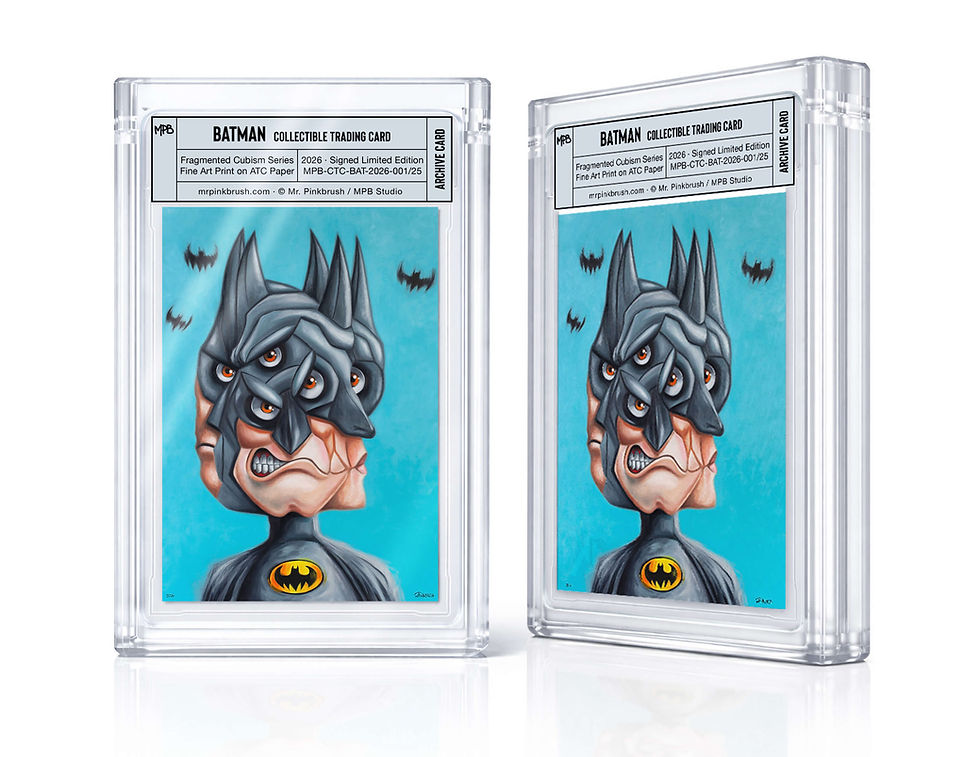
In the work of Fabian Frohly (Mr. Pinkbrush), cubist fragmentation is combined with clear
color planes, contemporary pop iconography, and character-based narration-not as a
quotation of modernism, but as a consistent continuation of Cubism into a globally
legible contemporary language.

Mr. Pinkbrush, Pinocchio, 2025. Oil on canvas.
Explore the current body of work by Mr. Pinkbrush – selected originals available.
Fragmentation today often merges with:
• pop art aesthetics
• urban and street-influenced visual languages
• contemporary character design
• clear graphic structures and intense color palettes
As a result, Cubism once again moves to the center of contemporary figurative painting.

Contemporary Cubism in the Global Art Market
International galleries and art fairs increasingly present fragmented cubist character painting
as an independent and contemporary visual language. From Paris to Miami, Hong Kong,
and London, Cubism has evolved from a historical movement into a living visual system.
Renowned galleries and institutions exhibit works that combine cubist principles with contemporary narratives – clear evidence that fragmentation remains one of the most relevant strategies in contemporary painting today.

Discover investable original fragmented cubism works by Mr. Pinkbrush – available now.
Within this renewed cubist landscape, Fabian Frohly, known as Mr. Pinkbrush, has developed
a distinctive position in fragmented contemporary figurative character painting.
His work expands Cubism through the combination of:
• clear geometric deconstruction
• contemporary pop-cultural references
• expressive, luminous color fields
• iconic, figuratively anchored visual narration
This position has resonated internationally. Notably, the work Mr. Pinkbrush World has received recognition from leading contemporary artists such as Takashi Murakami, whose engagement with the piece reflects a shared sensitivity for character-based imagery, color-driven composition, and the intersection of pop culture and fine art.
In addition, works by Fabian Frohly have been acquired and exhibited by the Museum Ground
in South Korea (Seoul), underscoring the institutional relevance of his approach within
a global contemporary art context.
A defining characteristic of Frohly’s work is the psychological depth with which his figures are constructed. Fragmentation does not function as a destruction of identity but as a deliberate layering of meaning. Emotional states, inner tensions, and themes such as resilience, inner strength, and adaptability are made visible as expressions of an active and self-determined engagement with reality.
His figures often embody strength through fragmentation. They do not appear broken, but composed, focused, and present. Visual fragmentation becomes a symbol of adaptability
and growth – the ability to generate energy from complexity.

In contrast to many dark or purely analytical approaches, Frohly consciously pursues a positive,
at times humorous perspective. Vivid colors, playful details, and iconic references create
a visual lightness that conveys strength and optimism without sacrificing conceptual depth.
This balance between psychological intensity, resilience, and accessibility is central to
his artistic language.
Rather than dissolving figures entirely, Frohly preserves recognizability. Fragmentation generates tension between abstraction, figuration, and recognition – positioning his work at the intersection of Cubism, Contemporary Pop Art, and modern figurative character painting.
This approach illustrates how Cubism is reimagined today-not as a historical reference,
but as a living, contemporary visual language, as explored within Cubism Art Today.
Why Fragmentation in Cubism Matters Today
Fragmentation reflects the conditions of contemporary life:
• visually overloade
• emotionally layere
• culturally fragmented
• globally interconnected

Contemporary cubist character painting translates this condition into a visual language that
is both intellectually rigorous and immediately impactful.
As positions such as that of Fabian Frohly demonstrate, Cubism today is no longer about breaking forms apart-but about reconstructing meaning.
Own an original fragmented cubism painting by Mr. Pinkbrush – view available works.
Further Reading
→ Learn more about Collectible Trading Cards Today in Contemporary Art


Comments