


Collectible Trading Cards Today in Contemporary Art

Updated: Apr 20
Why Small Works Are Becoming the Smartest Entry Point
in Contemporary Art Investment
You’ve seen Cubism before.
But not like this.
Now the same shift is happening in the art market.
The demand for collectible trading cards continues to grow rapidly in contemporary art.
You’ve seen trading cards before.But never within the context of contemporary fine art.
For decades, trading cards were seen as simple collectibles—linked to childhood, games, and pop culture. But something has changed.
A new category is rising fast: Collectible Trading Card Art.
Collectors are already buying.
The market is already moving.

In recent years, the global demand for trading cards has reached unprecedented levels.
Pokémon collectible trading cards, in particular, have seen record-breaking sales across international markets, attracting both collectors and investors.
This momentum has been further amplified by public figures such as Logan Paul,
whose high-profile acquisitions and media presence have brought trading cards back
into mainstream attention.
What was once considered niche has now become a globally recognized collectible category–laying the foundation for its evolution into contemporary fine art.
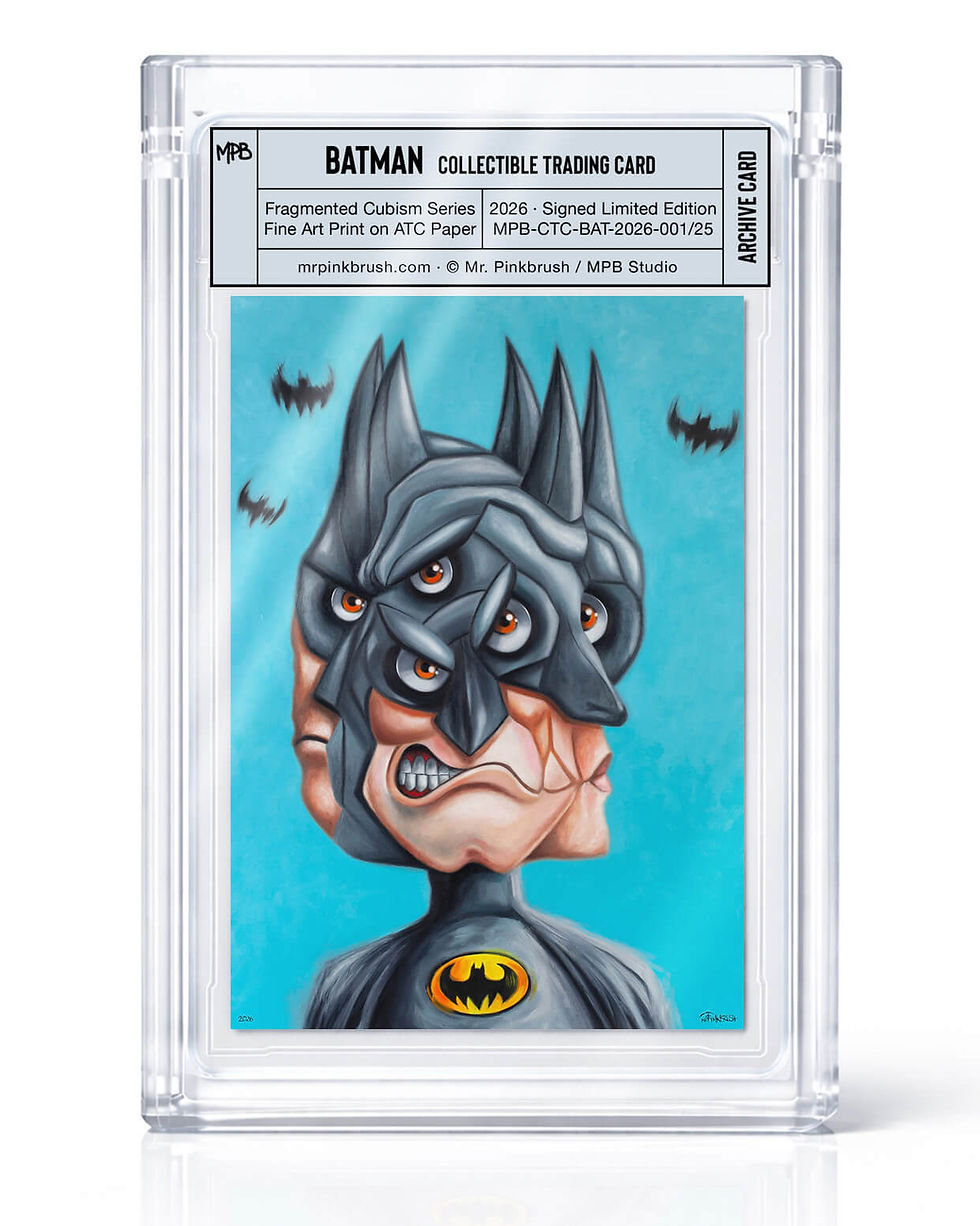
This shift is already reflected in the collectible trading card systems developed by Mr. Pinkbrush, conceived either as hand-painted Unique Works (original small-format paintings) or as
Signed Limited Editions, clearly distinguishing them from mass-produced counterparts.
Within this context, the relevance of this market becomes clearly visible within contemporary art itself:
Fabian Frohly, known as Mr. Pinkbrush, operates internationally, works with global collectors,
and collaborates with Warner Bros. Entertainment and DC Comics – a context in which collectible trading cards are not side products, but a strategic extension of an established artistic practice.
This makes one thing clear:
Collectible Trading Card Art is not a trend.
It is a market.
This is not mass production.
This is not decoration.
This is about Collectible Trading Cards as a Unique Work or as a Signed Limited Edition, positioned within contemporary fine art and early-stage art investment.
It is about owning a piece of an artist’s universe-early, rare, and accessible.

Why collectors are moving into small-format art
The contemporary art market has always been driven by one simple idea: access versus exclusivity.
Large paintings still dominate galleries and major collections. But they come with limits-high price, space, logistics, and slower access.
Smaller works remove these limits.
They allow collectors to enter earlier.
They allow collectors to acquire more works.
They allow collectors to build collections faster.
This is why small format fine art, limited edition prints, original artworks, and collectible trading card art are growing rapidly.
Collectible trading cards compress the essence of a large-scale artwork into a highly concentrated format – small in size, but not in meaning.
From pop culture to high-value collectible
The transformation is already visible.
Trading cards have evolved from simple printed objects into high-value collectible assets.
Brands like Pokémon and companies such as Topps have proven how rarity, condition,
and cultural relevance can drive massive value.
Historically, trading cards date back to the late 19th century, when they were first included in cigarette packs as collectible inserts. Over time, they evolved through sports cards and entertainment cards into global collectible systems – laying the foundation for today’s market.
At the same time, blue-chip contemporary artists are entering this space.
Takashi Murakami blends fine art with trading card culture through limited editions
and collectible projects.
KAWS built a global market through small collectible objects.
Damien Hirst explores scarcity through editions and new collectible formats.
These artists understand one thing:
Collectors don’t buy size.
They buy rarity, culture, and meaning.
The result is clear:
Collectors no longer separate art and collectibles.
They combine them.

A new category: Contemporary Character-Based Collectibles
We are witnessing the rise of a new visual language – contemporary collectible art built
on characters, identity, and culture.
This movement is rooted in:
• character-based compositions
• fragmented identity
• cultural symbolism
• emotional projection
Artists like George Condo and Daniel Arsham have shown how familiar forms can be transformed into high-value collectible art.
Collectible trading cards push this even further.
They take the character – the most direct emotional element – and translate it into a format that is:
• immediate
• portable
• collectible
• scalable
In this context, carefully developed series – such as those by Mr. Pinkbrush – position themselves not just as individual works, but as coherent collectible systems with long-term value potential, designed to be collected as part of a structured and evolving body of work.
Why size no longer defines value
In the past, size defined value.
Today, this is no longer true.
Value is driven by:
• artist relevance
• rarity
• concept
• timing
A small work released early can outperform a large work released later.
Why?
Because it gives access to the beginning of an artist’s trajectory.
Scarcity, timing, and the logic of early acquisition
Every collectible market follows the same rule:
Limited supply creates value.
When an edition is limited – such as 25 works – each piece becomes part of a closed system.
Once sold out:
Supply disappears.
Demand continues.
Collectors who buy early are not just buying an artwork.
They are securing position within a series.
Early collectible trading cards within a new body of work often gain disproportionate importance over time – especially within clearly structured series like those developed by Mr. Pinkbrush, where early editions – whether as a Unique Work or as a Signed Limited Edition –
define the foundation of the entire collectible system.

Materiality in a digital world
In a world dominated by digital images, physical art becomes more important.
A collectible trading card is not just an image.
It is:
• tangible
• ownable
• real
It can be held, stored, collected, and resold.
This creates real value in the global collectible art market.
Positioning within the contemporary art landscape
Within this shift, Fabian Frohly, known as Mr. Pinkbrush, operates at the intersection of Fragmented Cubism, Contemporary Character Painting, and collectible art – with selected works translated into Collectible Trading Card formats, as a Unique Work or as a Signed Limited Edition, for a new generation of collectors.
• Fragmented Cubism – a contemporary evolution of figurative painting, where identity
and perception are broken and reassembled
• Contemporary Character Painting – globally recognizable figures transformed into complex artistic narratives
• Collectible Art – limited, structured works designed for long-term value and collector relevance, often forming the foundation of curated collectible series
His work combines classical painting techniques with modern visual culture and
character-based identity.
This matters.
Because value is built through:
artistic depth + cultural relevance + market visibility
The collectible trading cards developed from this practice represent a natural extension –
as Collectible Trading Cards, either as a Unique Work or as a Signed Limited Edition,
within a broader artistic system.
Collectible Trading Cards as entry and expansion
For new collectors, collectible trading cards offer an easy entry into the art market.
They provide:
• access to Collectible Trading Cards as a Signed Limited Edition
• access to Collectible Trading Cards as a Unique Work
• lower entry points
• a way to build a collection
For experienced collectors, they allow:
• expansion of collections
• acquisition of early works
• development of structured series
In both cases:
limited, early, high-quality works – whether as a Unique Work or as a Signed Limited Edition – create the strongest long-term potential
The upcoming release
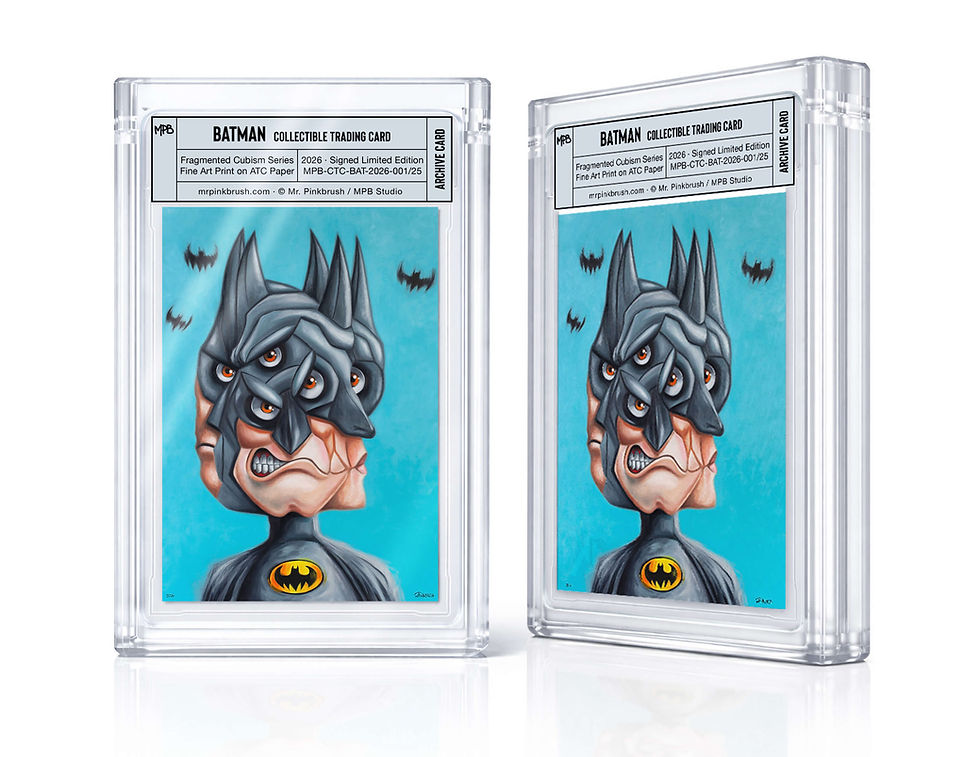
The first series of Mr. Pinkbrush Collectible Trading Cards has been developed with this exact logic.
Each piece is not a derivative product, but an independent artwork within a curated collectible system – as Collectible Trading Cards, either as a Unique Work or as a Signed Limited Edition.
The structure is precise:
• Signed Limited Editions
• Unique Works (one-of-one)
• collectible format
• strong conceptual identity
This is not about volume.
This is about scarcity, control, and long-term positioning in the contemporary art market.

Final perspective
Every art market has moments where new formats appear before they are fully understood.
Most people see them too late.
A few understand them early.
Those collectors win.
Collectible Trading Card Art is one of those moments.
And as in all collectible systems, the first works in a series are often the ones that define the highest long-term value.
Collector Access
Serious collectors understand one principle:
The best works are rarely available for long.
Early pieces within a structured series define the long-term narrative of a body of work.
Once placed in collections, they rarely return to the market.
The current release of Mr. Pinkbrush Collectible Trading Cards offers access to a limited number
of works within such a system – across Collectible Trading Cards offered as a Unique Work or as
a Signed Limited Edition, positioned at an early stage, with clear structure and long-term intent.
Access is intentionally limited.
Those who recognize the moment early tend to define the outcome later.
Own a Collectible Trading Card by Mr. Pinkbrush – explore available works.
→ Fragmented Cubism Today – redefining contemporary figurative painting and visual culture.


Comments